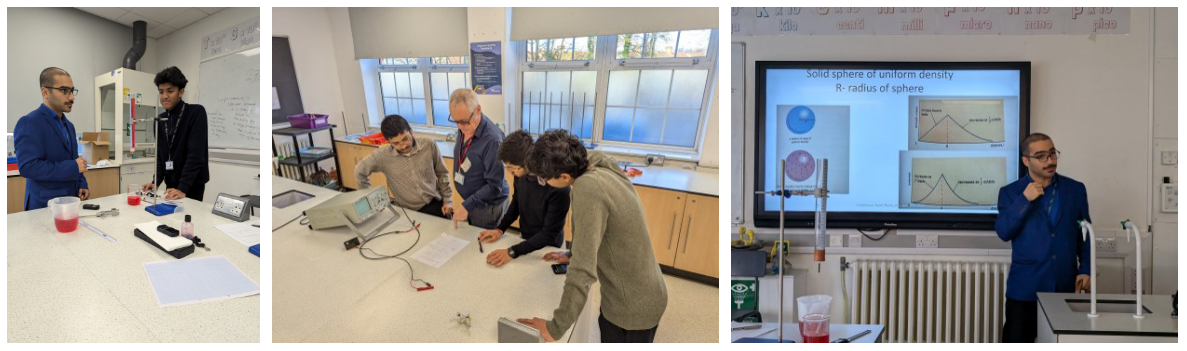
Following a student voice survey, a group of A Level Physics students interested in exploring in more detail the topic of ‘Waves Interference’, took part in a unique workshop put together by our science teacher Dr Mahmood and his Ogden trust mentor Mr Henderson.
The activity involved two practical workshops aimed at solidifying the students’ understanding of the concept and present the ideas from a different perspective, in addition to applying their knowledge to exam questions. The class was split in two groups: one group exploring the wave’s interference of sound with Mr Henderson, and the other exploring capacitors with Dr Mahmood, and then they swapped over. This is what each group covered:
Waves interference of sound
Students used their hearing and recorded on a tape measure when the sound became louder (constructive interference) or quieter (destructive interference). Then they used young double slit formula to calculate the wavelength of the sound wave and used that to calculate the frequency of the wave using the wave speed equation and compared their frequency to the one produced by the signal generator.
Capacitors discharge using plastic tubes
Using plastic tubes of varying diameters, our amazing science technicians adapted them to model capacitors (components that store electrical charge) by adding a numerical scale and a nozzle. Students then added water, modelling the charge stored in a capacitor, and dye, to make it visible. Then they used the nozzle to discharge the capacitor (letting the water out), and used their phones to record the discharge process (the ones with a larger diameter taking longer to discharge then those with a smaller diameter). Quantitatively, this was a great model and analogy for them to solidify their understanding; qualitatively, they looked at how the height of water changes (modelling charge in a capacitor) with respect to time. Then they used spreadsheets to plot a graph to model the exponential decay of the discharge of the capacitor with height difference against time.
Thank you to Mr Teemul and Ms Pindoria for their support in designing the plastic tubes and to Dr Mahmood and Mr Henderson for organising this unique workshop for the students.